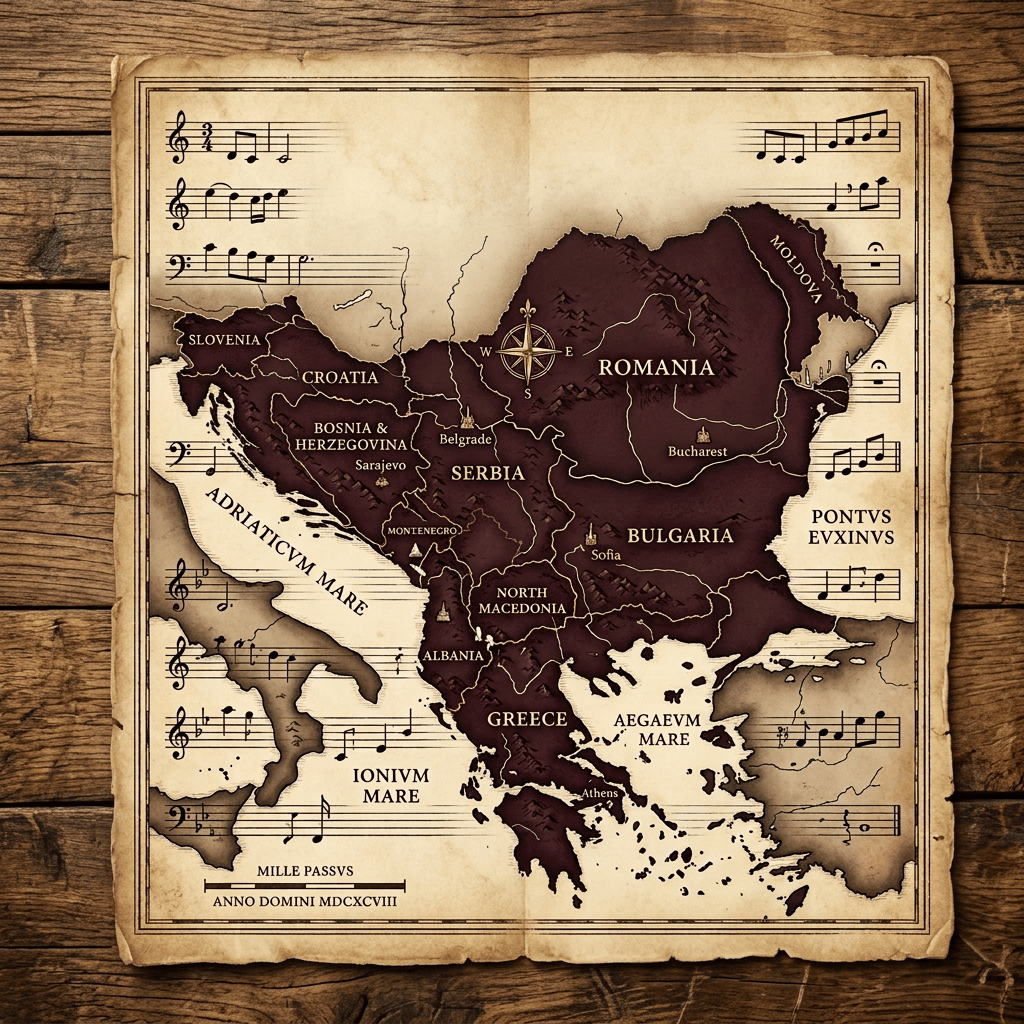
If you have never set foot in the Balkans, you have probably still picked up a familiar image of the region. War, feuding neighbours, chaos, and perhaps a certain wild passion. But where does this image come from, and more interestingly, do people from the region believe it about themselves? One place to look for an answer is popular culture. Dr Marin Cvitanović studied more than a hundred ex-Yugoslav pop songs by artists including Rambo Amadeus, Edo Maajka and Đorđe Balašević. The answer is yes, but people are not simply accepting the stereotype. They are singing along to it.
A word with a complicated past
The term “the Balkans” has never had a fixed meaning. It was first used to describe the area south of a mountain range in Bulgaria in the early 1800s, but its borders have shifted ever since depending on politics and events. Some scholars tie it to the legacy of the Ottoman Empire, which controlled the region for roughly 500 years. Others simply admit that no one has ever agreed on exactly where the Balkans begins and ends, or which countries belong to it.
What is clearer is the word’s spinoff, “balkanization.” It first appeared in the New York Times in 1918, describing fears that Europe could fracture the way the Balkans had. Over a century later, the term still gets used well beyond geography, applied to everything from workplace politics to computer animation, almost always as an insult implying disorder and backwardness. But what happens when the people it describes start using the stereotype themselves?
Why look at pop songs?
Geographers have long studied how novels, films and art shape the way we imagine a place. Music has received far less attention, despite arguably reaching more people, more often, in daily life. Songs are also unusually quick to reflect a society’s mood. A novel or film can take years to make it from idea to audience; a song can capture a moment almost as it happens.
The study therefore tracked down songs in Serbian, Croatian and related language varieties that mentioned “the Balkans” in some form, turning up 110 in total. Some of these used the word as a plain geographical reference, little more than a place name. But 75 of them used it as a loaded metaphor standing in for a whole mood, history or identity. Those 75 songs became the focus of the study, sorted into four recurring themes.
Theme one: a land destroyed by its own history
The most common theme by far ties the Balkans to war. Twenty three songs use the word “war” directly, and another twelve describe wartime suffering or plead for peace. The region’s association with conflict is not exactly unearned. The 20th century alone saw seven wars connected to the Balkans, from the Balkan Wars of 1912 to 1913 through both World Wars to the breakup of Yugoslavia in the 1990s. This history is part of why the region picked up the nickname “the powder keg of Europe.”
Hip hop artists in particular gravitated toward this theme. The genre began in the Bronx, born out of poverty and social breakdown, and its ability to give voice to the underprivileged travelled well to a region also grappling with economic collapse and ethnic division after Yugoslavia’s breakup. Artists like Edo Maajka became especially prolific here, with Balkan hip hop lyrics describing poverty, corrupt politicians, ethnic hostility and a sense that ordinary people are trapped by forces beyond their control, sometimes even blaming God for doing a poor job of making the region in the first place. A softer, more nostalgic version of this same theme appears in the work of older songwriters like Đorđe Balašević, who remembers pre-war Yugoslavia and mourns the divisions that followed, even while still describing the region as fundamentally broken.
Theme two: joy, passion and a very particular nightlife
Not every song is bleak. A genre known as turbo-folk, a high-energy blend of folk, pop, and dance music that became hugely popular in the 1990s, celebrates the Balkans as a place of intense feeling: passion, pride, festivity, and nights spent in traditional bars called kafanas, fuelled by music, alcohol and camaraderie. The term itself was coined by the Montenegrin musician Rambo Amadeus, who described it as “the fanning of the lowest of passions” in people, comparing it to fuel injection into an engine.
Turbo-folk’s rise is not politically neutral, however. The genre’s explosive growth in the 1990s is linked to Slobodan Milosevic’s regime in Serbia, with some research arguing that Milosevic exploited turbo-folk’s nationalist potential to win over a large population that had been moving from villages into cities. The genre’s culture of hedonism and escapism offered a kind of relief from poverty and Serbia’s international isolation at the time, and was contrasted by urban rock music, which was associated instead with Western values. Other scholars described turbo-folk as a joyful self-parody, embracing the very traits, backwardness, excess, rawness, that outsiders view negatively, and turning them into a badge of pride instead of something to be ashamed of.
Theme three: a “male” Balkans and a “female” Balkans
A third theme splits the region along gendered lines. The typical “Balkan man” in these songs is portrayed almost entirely negatively – aggressive, hypersexual, controlling, and physically imposing, someone who treats his masculinity, and his mistakes, as an unavoidable product of his surroundings. The “Balkan woman,” by contrast, is framed more positively, but only in a narrow sense. She is beautiful, proud and resilient, yet defined almost entirely through her relationship to men and her physical appeal, rarely as an independent figure in her own right. The study suggests this gendered split works as a kind of parallel to how the region itself gets described – it is wild and combustible on one hand, alluring but subordinate on the other.
Theme four: the Balkans as Europe’s “other”
The final theme concerns the Balkans’ uneasy place within Europe itself. Geographically part of the continent, the region is often treated as something apart from it, being less civilised, more “Eastern”, an internal outsider against which Europe defines itself.
The study connects this to a broader hierarchy across the former Yugoslavia, in which the northwest was long regarded as more civilised and valuable than the southeast. Yet “east” barely appears in these songs. Instead, musicians reach for the warmer, more romantic “south”, associated with sun and passion rather than backwardness, but still set against the West.
Slovenian rock band Zaklonišče Prepeva captures the contradiction. Their songs are nostalgic for Yugoslavia, drawing on its languages, music and shared cultural identity, yet they still reproduce the distinction between Slovenia and the Balkans. In “Alle Alle Slovenija”, Slovenia is heading towards Europe and NATO, while the Balkans is left behind: “Auf Wiedersehen Balkan, Selam Aleikum.”
The same pattern appears elsewhere in the songs: the Balkans is imagined as south of the West, but also as “south of happiness” itself.
Owning the stereotype, not escaping it
According to the study, what makes this pattern notable is not just that these stereotypes exist. It is that people from the region are not trying to shake them off. Of the 75 songs analysed, only about a fifth associate the Balkans mainly with positive qualities such as passion, beauty or pride, and even many of these do so with a sense of irony. Most of the songs instead focus on war, poverty, hatred and a sense that life is shaped by forces beyond people’s control. Yet rather than rejecting that image or replacing “Balkans” with a softer label like “Southeastern Europe,” as often happens in political language, these songwriters do the opposite. They take the stereotype and fold it into their own sense of identity, sometimes mocking it, sometimes mourning it, occasionaly wearing it like a badge of honor, but rarely denying it.
Perhaps that is the most revealing contradiction of all. The Balkans is not simply an identity imposed from outside, but neither is it something people in the region simply accept or reject. It is something they argue with, make fun of, romanticise and, ultimately, claim as their own.
Right now, somewhere in a smoky kafana, glass in hand, someone is singing about how broken this place is, and clearly having the time of their life. That, more than any textbook definition, might be the truest map of the Balkans.
Cvitanović, M. (2009). (Re)konstrukcija balkanskih identiteta kroz popularnu glazbu. Migracijske i etničke teme, 25(4), 317–335. https://hrcak.srce.hr/48368


Leave a Reply