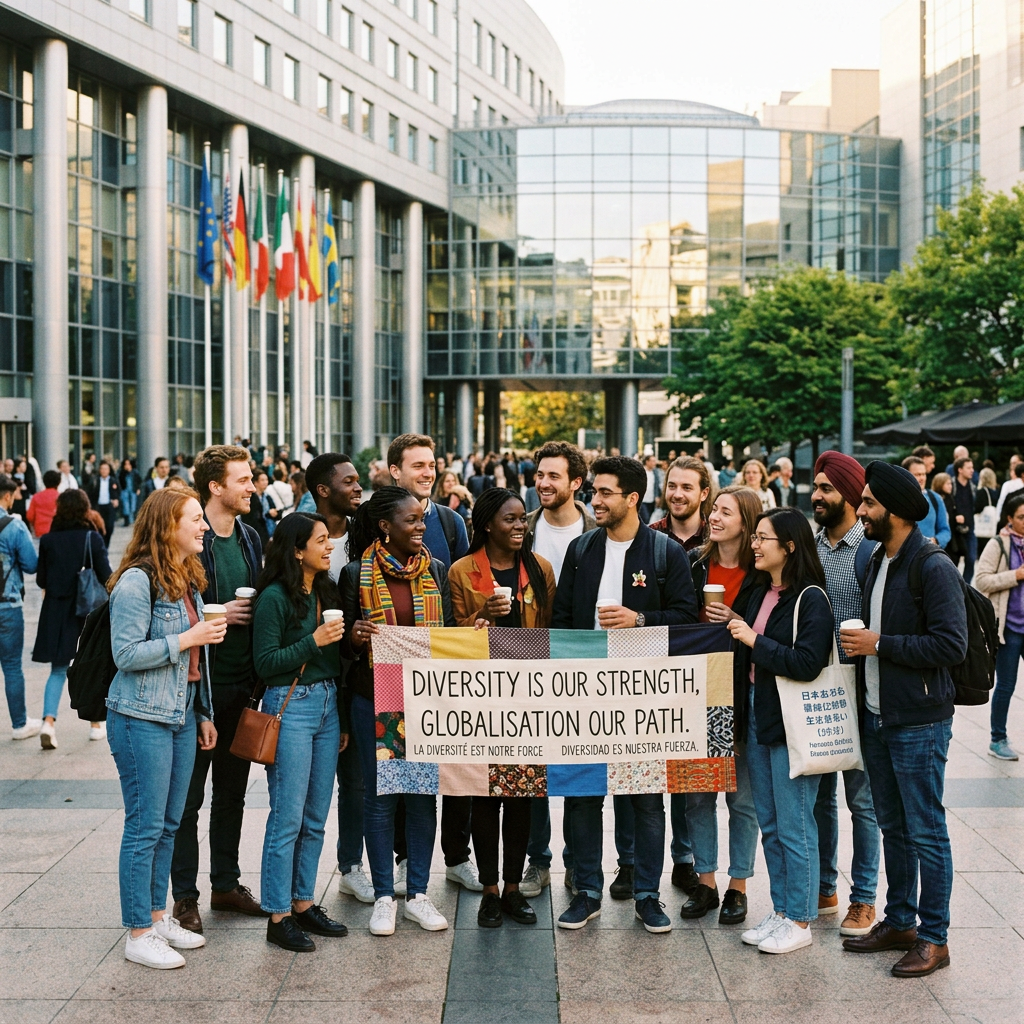
Almost everywhere in Europe, the same political story has been playing out. Support for radical right-wing parties has grown, Euroscepticism has hardened, and much of it has been fuelled by anti-globalist sentiment, the sense that global trade and open borders benefit some regions and people while leaving others behind. Brexit is the most visible example of this backlash, but it is far from an isolated one. Understanding why globalisation provokes such different reactions in different places has become one of the more pressing questions in European politics.
A team of researchers led by Marin Cvitanović from Bournemouth University and Jelena Lončar from the University of Zagreb decided to explore this question through a comparison that puts the two extremes of Europe’s recent EU story side by side. Croatia is the most recent country to join the EU. The UK is the only country to have left it. Surveying students in both countries between 2019 and 2020, the researchers wanted to find out whether young people’s attitudes to globalisation depend more on shared economic pressures across Europe, or on the particular history and identity of the country they come from.
What they found suggests that broad talk of pro or anti-globalisation attitudes can hide more than it reveals. Ask a young person in Britain and a young person in Croatia what they think of globalisation, and you get a surprisingly similar answer. Both are likely to say it is, on balance, a good thing. Dig a little deeper, though, and the agreement falls apart. What worries a Croatian student most is not what worries a British one, and the reasons trace back to two very different national histories.
Both groups turned out to see globalisation in a largely positive light, and named much the same benefits, chiefly the exchange of knowledge and scientific progress alongside economic growth. They also agreed on its sharpest downside worldwide, pointing to rising economic inequality and the exploitation of workers. On paper, then, this looks like consensus.
Where the histories start to show
The agreement breaks down as soon as the questions turn closer to home. Croatian students were far more likely to name loss of sovereignty and the erosion of national culture as globalisation’s biggest threat to their own country. UK students worried instead about growing inequality and struggling small businesses, with sovereignty barely registering as a concern.
The researchers trace this split back to two very different histories. Britain’s long history as a colonial power brought waves of migration over generations and built a society already used to holding multiple layers of identity, comfortable describing itself as European or global as well as British. Croatia’s story is much more recent and much more fragile. It only became an independent state after the breakup of Yugoslavia in the 1990s, in a period marked by war and a deliberate, state-led effort to build a national identity from the ground up, through school curriculums, place names and sport. That recent and hard-won process of nation-building appears to leave Croatian students holding on more tightly to their cultural identity, and more anxious about anything that seems to threaten it.
One open-ended survey response put this plainly. A Croatian student described it as a feeling that you are told your culture is worth less, once it sits alongside bigger, more powerful nations. Others reached for words like Americanisation, Westernisation and McDonaldisation to describe what globalisation looks like from a small country’s vantage point.
Small country, big worry
Size runs through the results just as much as history does. Croatian students were considerably more inclined than their UK peers to see large, wealthy countries as the winners of globalisation and small countries as its losers, and they were far more supportive of Croatia taking on a bigger role internationally than UK students were of Britain doing the same.
This fits with a long-standing argument in economic research, that smaller countries carry particular disadvantages under globalisation, from having less influence over prices and policy to being more exposed when trade conditions turn against them. For a country of under four million people that has only recently found its footing on the international map, those pressures translate naturally into a sharper sense of vulnerability, and perhaps into a wish for more of a seat at the table.
The bigger picture
What this study really captures is not a disagreement about whether globalisation is good or bad. Both groups landed on much the same overall verdict. The real divide is over what globalisation threatens to take away, and that answer depends heavily on where a country sits in relation to power, size and history.
For UK students, coming from a large, historically dominant, multicultural society, the sharpest worry is economic fairness. For Croatian students, coming from a small country still shaping a post-war national identity, the sharper fear is losing a sense of who they are. Neither view is simply about economics or simply about culture. They are two different lenses shaped by two very different national experiences, layered onto the same global process.
The researchers see this as a reminder that debates about globalisation, immigration and EU integration cannot be reduced to straightforward economic self-interest. National history, exposure to multiculturalism, and a country’s size and standing in the world all shape how its citizens read the same set of global forces. As younger generations across Europe keep navigating questions of trade, migration and cultural exchange, understanding these underlying differences may matter just as much as knowing whether people support or oppose globalisation in the first place.
Cvitanović, M., Loncar, J., & Braicic, Z. (2023). “There is a feeling that your culture is worth less”: A comparison of British and Croatian students’ attitudes towards globalisation. Mitteilungen Der Oesterreichische Geographische Gesellschaft, (164), 337–360.


Leave a Reply